

Stills 400
One stock. No switcher, no restock. It's applied while the roll develops on your phone, about a second a frame — which is why every frame comes back the same way, and why you can't undo it.
Stills 400 is the film process inside Stills, the disposable camera app for iPhone. It is not a lookup table dragged over a finished JPEG. It is a small pipeline — exposure, halation, tone, grain, in that order — that runs on the phone when a roll develops, and it is the reason a Stills frame looks like something that came back from a lab rather than something that came out of a filter menu.
Three frames, and what to look at
These are exports, not mock-ups. On a pointer device, hover any of them to bring up a loupe — it magnifies that file’s own pixels, so the grain you see is the grain that is in it.
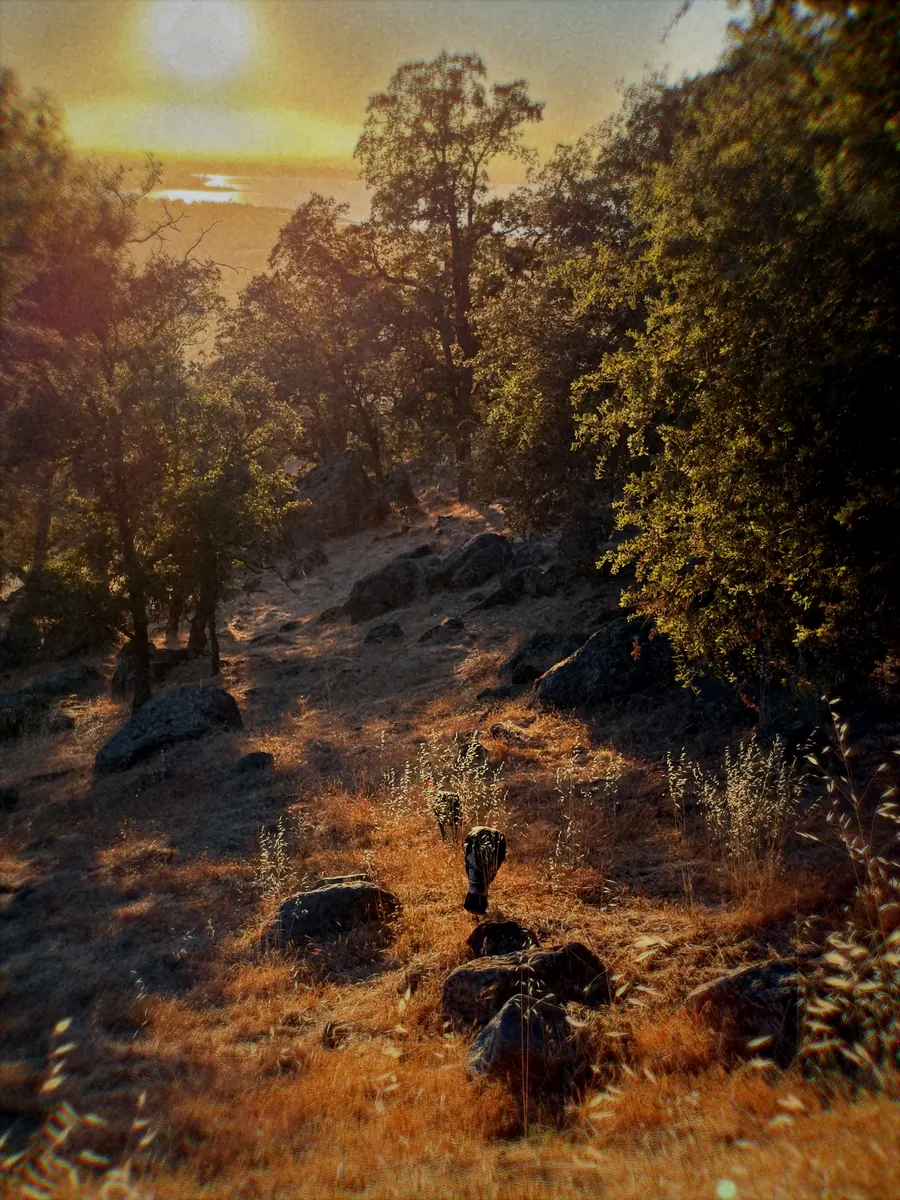
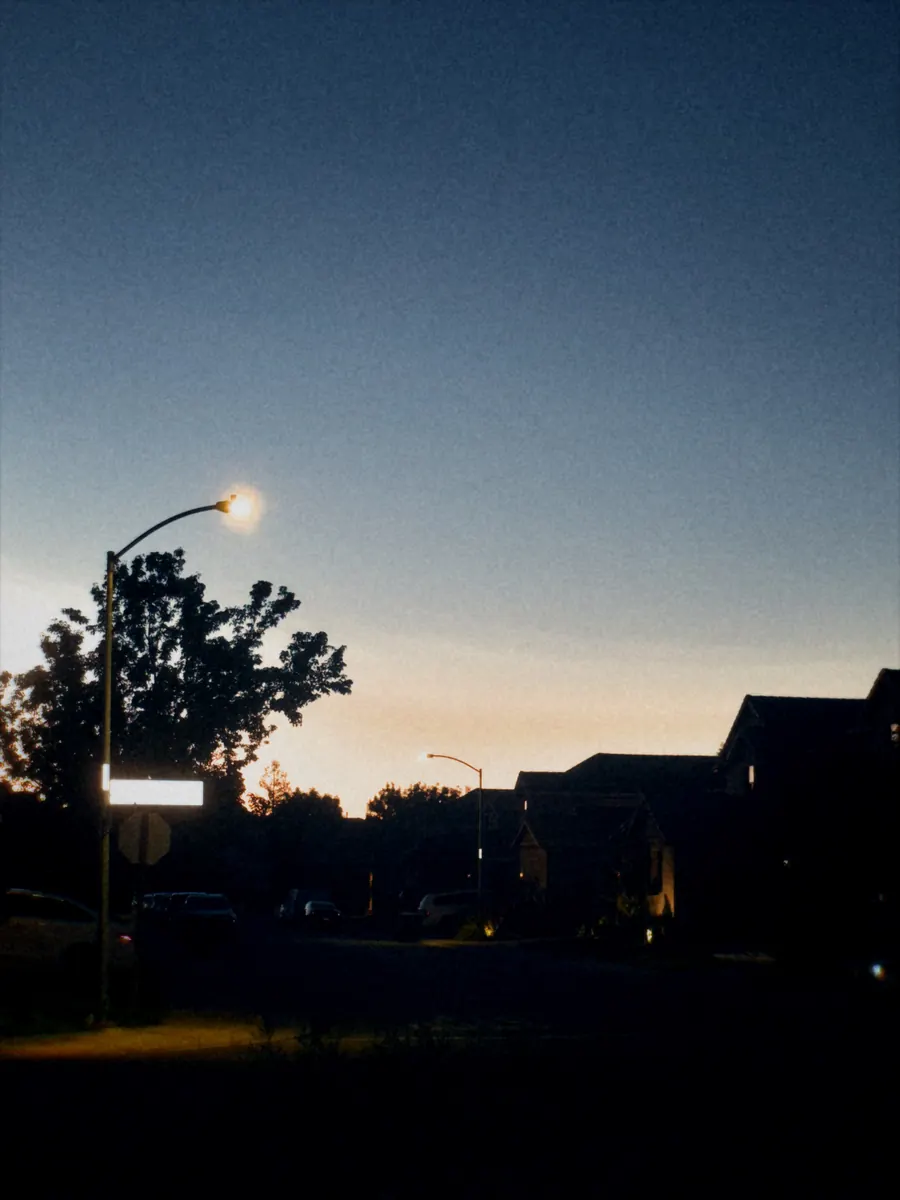
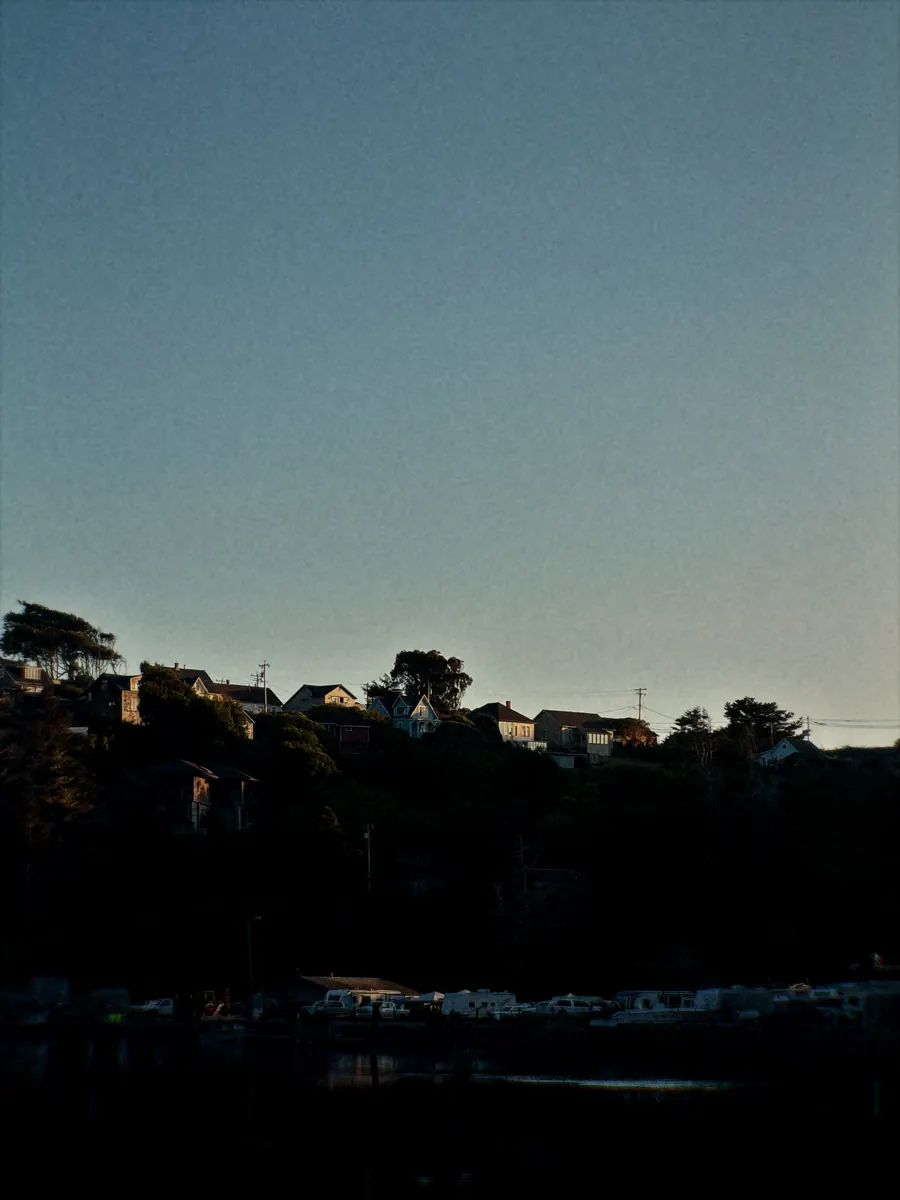
- Golden mids. Look at the dry grass. It is warm without being orange, and the shade under the trees is charcoal rather than black.
- Halation on light. The amber ring around the lamp. It sits inside the glow rather than on top of it, and it is not there around the sky.
- Grain you can see. The flat dusk sky is where grain has nowhere to hide. Loupe it and then look at the thumbnail again.
What it does to a frame
Four things, in a fixed order, because the order is most of the difference between film and a filter.
1. Golden midtones over a matte toe
The tone curve lifts the shadows off pure black and holds them there, so darkness in a Stills frame is charcoal rather than a hole. Midtones warm as they brighten; highlights run to honey rather than to white. Nothing is tinted — there is no colour layer over the top. The warmth is what the curve does on its way up, which is why it survives being screenshotted, re-compressed and posted somewhere else.
2. Halation, computed before the tone curve
On real colour negative, bright light passes through the emulsion, bounces off the back of the film base and re-exposes the layers from underneath. It blooms, and it blooms red, because red is what makes it back through. Stills 400 does the same arithmetic in the same place in the chain: the bloom is added to the light, before tone mapping, not painted onto the finished image afterwards.
That ordering is the whole trick. A glow added at the end sits on top of a photograph and reads as a smear. A glow added before the curve gets compressed by the curve along with everything else, and reads as light that was genuinely too strong for the film to hold.
3. Two octaves of grain
Grain is weighted to the midtones and fades out of both the deep shadows and the bright highlights, which is where it goes on real stock. It is generated at two scales so that it survives being scaled down — a single fine octave disappears the moment a frame becomes a thumbnail, and a thumbnail is where most photographs are actually looked at.
4. A little less than you would choose
Every one of the above is dialled below the point where it announces itself. The test we kept coming back to is whether a frame still looks like a photograph of the thing rather than a photograph of an effect. If you notice the film before you notice the picture, the film is turned up too far.
Why there is only one
Because a disposable camera does not let you pick the film after you have shot the frame, and almost everything good about shooting one comes from that.
A stock switcher turns developing into a decision, and a decision turns a roll of photographs into a pile of drafts. You would develop, dislike it, try another stock, and end up doing colour grading in an app whose entire premise is that you are not going to. One emulsion means the roll comes back and it is finished. What you get to do with it is look at it.
It also means the frames go together. Twenty-seven pictures shot across an afternoon on one stock read as an afternoon. The same twenty-seven with four different looks read as a folder.
Where it runs
On the phone, at roughly a second a frame, using the GPU. The progress you watch in the darkroom is the actual work, not a timer pretending to be one — which is also why a twenty-seven frame roll takes about half a minute and a twelve takes about a dozen seconds.
Nothing is uploaded to develop a roll. There is no server in the path, no queue, and no version of this that needs a signal. A roll shot on a plane develops on the plane. What is and is not collected is written out in full.
The name
400 is the ISO the process is tuned around: fast enough for late afternoon and indoors, grainy enough to look like it. Stills does not simulate other speeds. There is no 100 and no 800, and there is not going to be a pack of them for sale.